

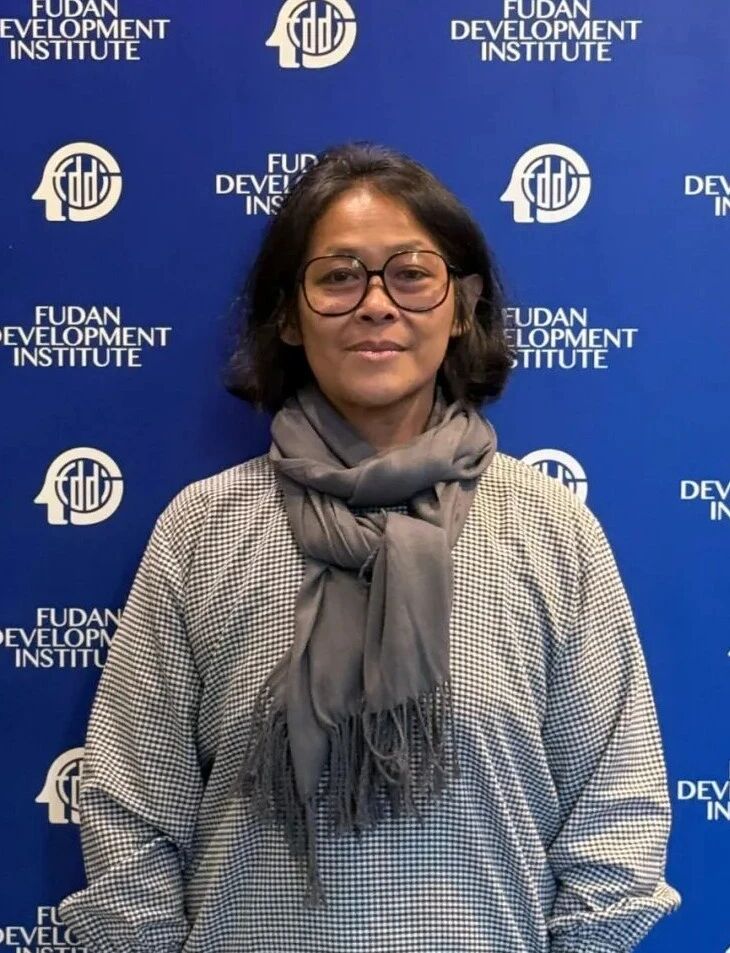
As artificial intelligence becomes part of everyday life, digital inclusion is no longer just about access to devices or the internet. It raises broader questions about vulnerability, dignity, and social responsibility. For Endah Triastuti, Visiting Scholar at Fudan Development Institute (FDDI) and associate professor at Universitas Indonesia, digital inequality is not a technical problem to be solved, but a social condition that requires careful governance and human-centered design.
Triastuti, also a senior researcher at Universitas Indonesia’s Asia Research Centre , approaches digital issues through lived experience. Her research asks a simple but persistent question: who benefits from digital transformation—and who is left out?
Researching Inequality Through Personal Experience
Triastuti’s academic interests grew out of moments that challenged her assumptions about technology and progress. During her doctoral studies in Australia, she learned that some remote communities still lacked basic internet infrastructure. For someone who had grown up in cities where connectivity was taken for granted, the realization was striking.
“It made me realize that many people have never truly entered the digital world,” she said. The experience led her to think more critically about the uneven spread of technology and the structural nature of digital exclusion.
Her perspective was further shaped by her experience growing up in Indonesia. As a woman, she became more attentive to groups that are often ignored or silenced. In earlier research, she focused on women living with HIV, many of whom were both muted and stigmatized, with limited access to antiretroviral therapy (ARV). She examined how these women used anonymous blogs not only to share their stories, but also to build an inclusive online community where practical information—such as how to access ARV treatment—could be exchanged. “They were not writing for money,” she said. “They just wanted to be heard.”
These encounters gradually pushed her away from data-heavy approaches and toward digital ethnography, which focuses on everyday practices and social contexts. While she had previously worked with large datasets, she became increasingly cautious about their limits. “Some of the social media data tells nothing about reality,” she said. “Bots and coordinated accounts even distort it.”
Digital Literacy Beyond Technical Skills
In her lecture at Fudan University, Triastuti placed digital literacy within the context of global aging. Citing data from the World Health Organization, she noted that by 2030, one in six people worldwide will be aged 60 or above, and by 2050, most older adults will live in low- and middle-income countries.
This demographic shift, she argued, overlaps with rapid digitalization and deepens what she described as multiple layers of the digital divide. Access alone is not enough. Age, health, education, and social support all affect how older adults use digital services such as online banking, telemedicine, and e-government platforms.
Triastuti pointed out that most digital literacy programs focus narrowly on technical skills. What they often ignore are social and emotional factors. “Scams and misinformation don’t just target a lack of knowledge,” she said. “They target loneliness, fear, and insecurity.”
The spread of AI-generated content has made these challenges more serious. Highly realistic images and videos blur the line between real and artificial information, making it harder for older adults to judge what they see online. For this reason, Triastuti emphasized the importance of human-in-the-loop governance. Older users rarely navigate digital systems alone. Instead, they rely on family members, healthcare workers, and community staff to help them manage risks and make decisions.
Observing China’s State-led Community-Based Approach
During her visit to Fudan University, Triastuti observed how digital governance in China is closely linked to community life. What impressed her was not only technological development, but the social support built around it.
She noted features such as simplified “senior modes” in popular apps, which offer larger fonts and clearer interfaces. She also observed volunteer programs—often involving university students—that provide in-person guidance for older adults. “Face-to-face teaching really works.”
Triastuti viewed these practices as part of a people-centered approach to governance. She drew a clear line between control and governance, arguing that responsible regulation serves social well-being rather than power. “Control is for power,” she said. “Governance is for society.”
Looking ahead, Triastuti plans to continue studying digital inclusion and AI governance in aging societies, particularly from the perspective of the Global South. She hopes to contribute to discussions on how global AI frameworks can better reflect social realities outside the Global North, and how community-based practices can support more inclusive digital systems.
For her, digital inclusion is not a one-time policy goal, but an ongoing ethical task. As societies grow older and technologies become more powerful, the key question is no longer whether people can go online, but whether digital systems are designed with care for those most at risk of being left behind.
(END)
Writer: LI Wenyi
Proofreader: YANG Xinrui
Editor: WANG Mengqi, LI Yijie