

“Sustainability is not something technical; it is deeply political, territorial, and full of contradictions,” said Dr. Aico Sipriano Nogueira, a visiting scholar at Fudan Development Institute (FDDI) and an Assistant Researcher in the Department of Sociology at the University of São Paulo.
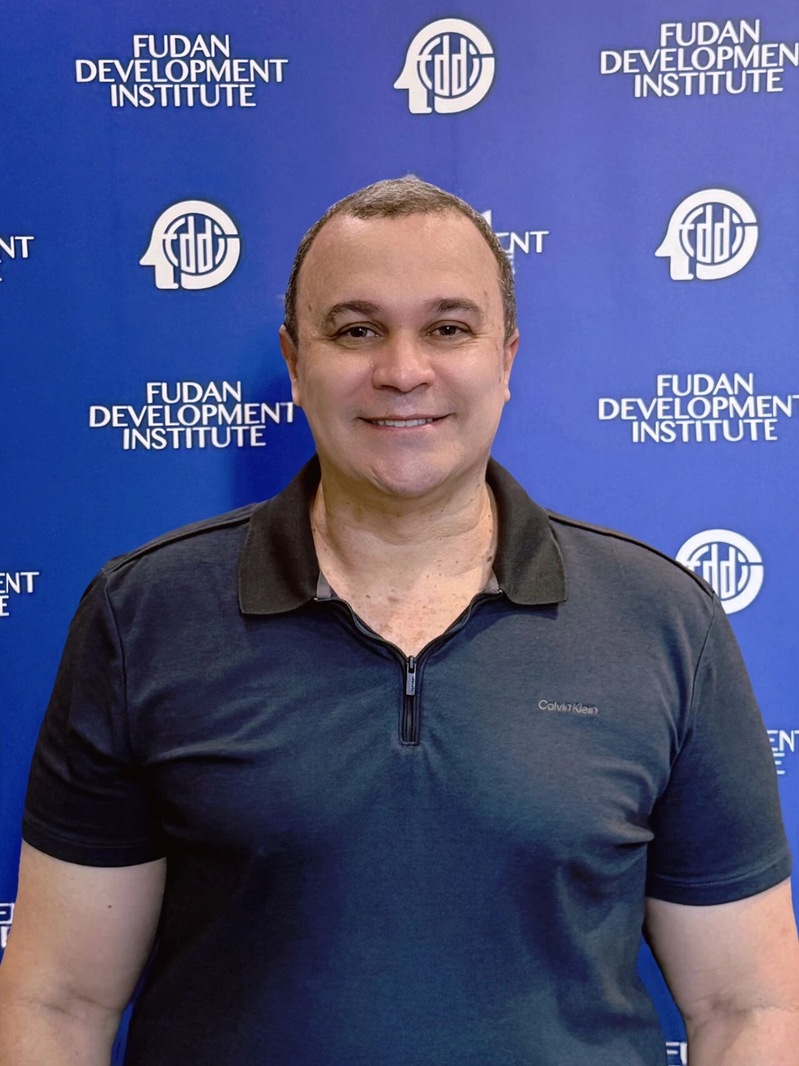
As a sociologist, Nogueira studies how rural communities and social movements in socially and ecologically contested territories contribute to institutional innovation and sustainable governance, with a particular focus on agri-food systems, environmental justice, degrowth, and grassroots responses to socio-ecological crises. He has also worked with institutions such as the World Bank, FAO, UNDP, Brazil’s Ministry of Social Development, and the National Confederation of Rural Workers, combining technical expertise with long-term engagement in rural territories.
Q: Your work spans agri-food systems, environmental justice, and social movements. What problem ties these threads together, and how has it evolved over time?
Nogueira: My main concern has always been how to understand sustainable transitions in concrete territories. Early in my career, working with organizations such as the World Bank and UN agencies, I saw how often they rely on standardized models that are supposed to work everywhere. But when you travel across a country like Brazil and meet people in very different rural communities, you realize that transitions are highly asymmetric: what “sustainability” means in one place may be almost the opposite in another.
That experience convinced me that sustainability is not primarily a technical problem. It is a profoundly political and territorial one, embedded in conflicts over land, resources, and development models. This is why I chose to work in regions marked by long histories of socio-environmental conflict. In the south of Bahia (the 5th-largest state in Brazil), you find indigenous communities, quilombola communities formed by descendants of enslaved people who escaped plantations, landless workers’ movements, small farmers, and local governments—alongside large agribusiness and agroforestry corporations. All these actors coexist and clash in the same territory. My research asks: how do they negotiate, resist, and sometimes re-invent governance arrangements under these conditions?
Q: In Bahia you study polycentric governance in a region shaped by eucalyptus monocultures. What does this governance arrangement look like in practice?
Nogueira: In the south of Bahia, large corporations have expanded eucalyptus plantations over the last 20–25 years to produce pulp for the global paper industry. Their arrival intensified long-standing conflicts over land and water with indigenous groups, quilombolas, landless workers, and small farmers. At one point, landless movements began to occupy company farms to pressure the state and the firms for agrarian reform and recognition of local rights.
Interestingly, the companies themselves asked the University of São Paulo for help. Over time, local actors, social movements, corporations, researchers, and public authorities co-constructed a form of polycentric governance inspired by Elinor Ostrom’s work: instead of one central decision-maker, power and decision-making are distributed across multiple centers. In practice, this meant that corporations agreed to provide land, support agroecology schools, and offer technical assistance to small producers, while social movements and communities gained new channels to influence land-use decisions.
It is not a harmonious or perfect model—there is mistrust, unequal power, and many contradictions—but the situation is better than in the past. The governance system became an arena where conflicts are recognized and negotiated rather than simply repressed or ignored. That is what interests me: how territories invent institutional arrangements that are messy, contested, but still capable of tempering the worst impacts of extractive development.
Q: Your current research at FDDI compares Brazil and China through the global pulp and paper chain. How did you arrive at that comparison, and why does it matter?
Nogueira: Initially, I focused on local resilience—how communities in Bahia creatively respond to socio-environmental crises. Over time, I realized that to fully understand their situation, I needed to understand business as well: the global commodity chain of eucalyptus, pulp, and paper.
Brazil and China are deeply interconnected through this chain. Brazil supplies large volumes of pulp; China produces pulp domestically but also imports significant quantities from Brazil, Chile, and other countries, and then industrializes it, producing paper and influencing global prices. So Brazil and China participate in the same global business, but in very different positions.
This raises important questions. In Brazil, the national strategy is framed around an “agroecological transition,” with highly contested implementation in democratic but unstable political cycles. In China, debates around “ecological civilization”—now part of the constitution—signal a strong, top-down state commitment to reconciling development with environmental protection. My research asks how these different sustainability narratives and strategies shape concrete land-use decisions and community livelihoods in places like Bahia and Guangxi, where eucalyptus plantations and pulp production are transforming rural landscapes.
Q: You have worked with the World Bank, FAO, UNDP, Brazilian ministries, and large NGOs. How have these experiences shaped your view of sustainability and governance?
Nogueira: In a way, I’m a product of that ecosystem. Each experience contributed something different. The World Bank, for example, gave me a solid technical foundation in quantitative analysis, models, and indicators. But I also saw these institutions’ limits. Some reports can be very official, and present a world where everything works.
UN agencies such as FAO and UNDP are often closer to the ground, but they also follow global conceptual fashions. At one point, everyone talked about “social capital”; later, “sustainable livelihoods” became the keyword. Concepts circulate through conferences and reports, and suddenly every project is framed around the same word.
Working for the Brazilian government and for the National Confederation of Rural Workers confronted me with yet another reality. Each four-year government can change priorities, dismantle programs, or rebuild them. You see long, patient work in rural territories being advanced under one administration and then almost erased by the next. At the same time, you learn how social movements and parties interact, cooperate, and sometimes clash in the process of making policy.
What I take from all this is the need to bridge technical and political skills: understanding data, models, and institutional designs, but also knowing how people actually live, organize, and negotiate in specific territories.
Q: What advice would you give to early-career researchers and policymakers who want to work on rural development and environmental sustainability?
Nogueira: I often tell my students that sociology is an “adventure of the eyes.” Theory trains you to see what others cannot see: power relations, structures, and historical legacies that are invisible in everyday common sense. Concepts are crucial, and serious theoretical training is indispensable.
But theory alone is not enough. Many social scientists I know have never been to the places they write about. They have never spent time in the communities whose cases appear in their papers. For me, growing up in a very poor neighborhood on the outskirts of São Paulo, and later travelling through Brazil’s rural regions—from the south of Bahia to communities deep in the Amazon—was transformative. Seeing how people live, how they struggle, and how they invent solutions changes the way you think and write.
So my advice is twofold. First, cultivate strong conceptual and methodological skills; learn to work with both qualitative and quantitative tools. Second, never lose contact with the realities you study. Go to the field if you can. Listen carefully. Allow what you see to challenge your assumptions. And if you decide to move between academia and policy institutions—international organizations, NGOs, or governments—be aware that careers are structured differently. These experiences can enrich your work enormously, but they also require you to navigate discontinuities and to consciously build bridges back to research. Ultimately, meaningful work on sustainability and rural development comes from combining rigorous analysis with a deep, humble engagement with people’s lives.
(END)
Writer: LING Jialiang
Proofreader: YANG Xinrui
Editor: WANG Mengqi, LI Yijie