
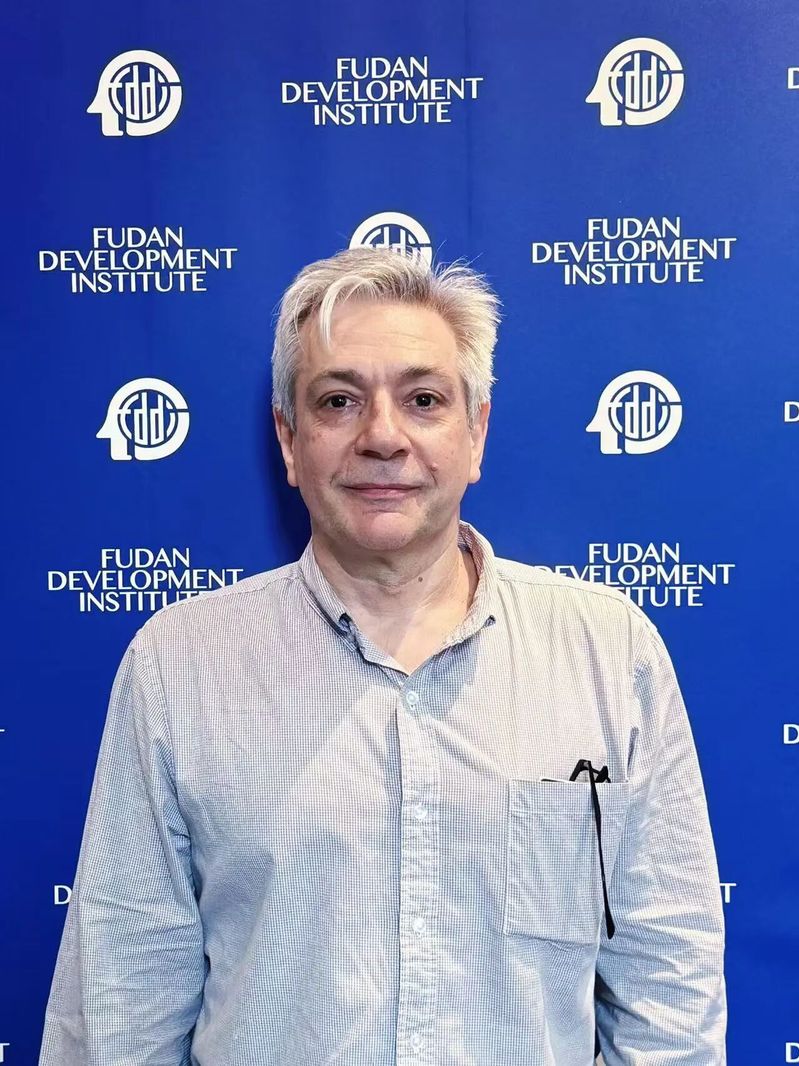
As technological transformation accelerates worldwide, understanding how emerging technologies reshape development paths has become a pressing question—especially for countries in the Global South. Professor José Eduardo de Salles Roselino Junior, an economist from the Federal University of São Carlos (UFSCar), recently spent several weeks at Fudan Development Institute (FDDI), conducting comparative research on digital transformation, industrial policy, and innovation capacity in China and Brazil. During his stay, he reflected on his motivations, key insights, and overall experience at Fudan.
Q: What first motivated you to study the economics of technology and national development?
Roselino: Since my earliest years at university, I have been drawn to topics linking technology and economy. That interest led me to specialize in the economics of technology, industrial policy, and development strategy. As a Brazilian scholar, my central concern is how Brazil can overcome underdevelopment.
China naturally became a major reference in my research. Its rise as both an industrial and technological powerhouse, and its achievements in innovation and poverty alleviation, constitutes one of the most remarkable transformations in modern economic history. Understanding China’s trajectory is essential for anyone studying development.
Q: How does your current research at FDDI build on your broader work, especially on technological rivalry?
Roselino: My previous studies argue that technology is not neutral; it is embedded in geopolitical and economic competition. Concepts such as AI, cloud computing, and cyber-physical manufacturing should be viewed not only as innovations but also as elements of techno-policy and techno-nationalism.
At FDDI, I extend this perspective by comparing China’s and Brazil’s digital transformation. The two countries have very different productive structures, and these structural asymmetries determine how each can adopt, absorb, and benefit from new technologies.
Q: What key differences do you observe between China and Brazil in their digital transformation strategies?
Roselino: China is able to direct new technologies toward improving public services and raising industrial productivity—whether in smart cities, healthcare, education, or advanced manufacturing. In Brazil, digital transformation is concentrated mainly in finance and commerce. We have strong e-commerce, but limited integration between digital technologies and productive sectors.
Brazil’s industrial policies are conceptually sound, but high real interest rates and chronic exchange-rate volatility make long-term industrial investment very difficult. These macroeconomic constraints sharply distinguish Brazil’s experience from China’s.
Q: How would you characterize Brazil’s talent landscape and its challenges in AI and innovation?
Roselino: Brazil has excellent human resources in engineering, computer science, and software development. We produce high-quality scientific research and even export IT outsourcing services. But as is commonly observed in Brazil: Brazil has science, but not technology.
The problem is applying scientific knowledge to productive sectors. Many of our best engineers and AI specialists choose to work in banks because salaries there exceed those in manufacturing or tech-intensive industries. This disconnect between talent and industry limits Brazil’s innovation capacity.
China’s coordination between universities, state-owned enterprises, and private firms—aligning research with national strategy—provides an important model for Brazil.
Q: What opportunities do you see for deeper China–Brazil cooperation, especially in e-commerce and digital platforms?
Roselino: Brazilian consumers widely use Chinese platforms like AliExpress and Temu, but digital flows remain mostly one-directional. The deeper opportunity lies in two-way e-commerce, linking small Brazilian producers directly to Chinese consumers.
China’s experience with Taobao Villages (a term coined by Alibaba to describe villages where at least 10% of households engage in e-commerce), shows how digital platforms can uplift rural communities. Brazil has many high-quality products produced by low-income families such as honey and propolis. These could reach Chinese markets through digital channels, generating shared benefits and reducing inequalities.
Looking ahead, Brazil also seeks cooperation in technological transfer, AI, critical-mineral processing, and innovation partnerships.
Q: How has your experience at FDDI and Fudan University been?
Roselino: My experience has been outstanding. This is my third time in China, but my first extended stay at Fudan. The academic environment is vibrant, open, and deeply inspiring. At FDDI, I had the chance to participate in seminars and roundtables, exchanging ideas with scholars from Asia, Africa, Europe, and Latin America.
Living in Shanghai also allowed me to truly experience Chinese society, culture, and everyday kindness. My wife joined me toward the end of my stay, and we explored the city together. To understand China, you cannot rely solely on books—you must be here. I am already looking forward to returning.
Looking Forward
Professor Roselino’s research at FDDI highlights the importance of comparative analysis in understanding how different national contexts shape technology adoption and industrial development. His work on China–Brazil digital transformation offers valuable insights for policymakers and scholars seeking to navigate the complexities of technological change in the Global South.
(END)
Writer:LI Siyu, Edward Eldar Turdmat
Proofreader: YANG Xinrui
Editor: WANG Mengqi, LI Yijie