Madelyn Ross, President Emeritus of the US-China Education Trust (USCET), recently returned to Fudan to share her story and her thoughts on educational cooperation between the two countries.
As one of the first American students to come to China after the establishment of diplomatic ties between the two countries, Ross studied at Fudan from 1979 to 1980. Fresh from earning a B.A. in East Asian Studies at Princeton, she taught English while taking courses in Chinese literature at Fudan.
This experience laid the groundwork for her career devoted to US-China exchange. Before joining USCET, she served as executive director of SAIS China and associate director of China Studies at Johns Hopkins University School of Advanced International Studies. She worked at George Mason University from 2003 to 2015, as the director of China Initiatives across the university. She also spent 9 years at The US-China Business Council, as editor of The China Business Review and executive director of The China Business Forum.


Standing again at Fudan’s main gate, she recreated a black-and-white photo taken 45 years earlier, and the memories sealed inside it sprang back to life.
The chance to go to China
“I feel a little emotional because the last time I spoke to the students and faculty at Fudan was 45 years ago,” she said at a panel discussion hosted by Fudan’s Center for American Studies, during her visit.
In the late 1970s, Ross was then a college student with a growing fascination for Chinese language and culture. She had never imagined going to China—until the announcement of The Joint Communiqué on the Establishment of Diplomatic Relations on December 15, 1978.
Later that month, the first 52 Chinese students flew to the United States, and one month later, 8 American graduate students landed in China, several of them at Fudan.
Top universities on both sides began to re-establish ties, Fudan and Princeton among them. “I was at Princeton, and I was interested in learning at Fudan, so I became one of the first people to benefit from the new agreement that the two universities signed at that time,” Ross said.

Former President of Fudan University SU Buqing’s invitation
In July 1979, Ross received a brief letter from SU Buqing, then president of Fudan University, inviting her to teach English while learning Chinese at Fudan. The closing line “We are expecting your arrival at the beginning of the fall semester” put her on a plane to Shanghai a few weeks later and launched what she still calls her unforgettable “work-study” life at Fudan.
“Will anyone be there to meet me? How do I get to campus?” She still remembers landing in Shanghai for the first time. What she hadn’t expected was two professors from the English Department—DONG Yafen (later interpreter on behalf of Fudan for Ronald Reagan’s 1984 Fudan visit) and DING Zhaomin—were waiting at the gate.
The first weeks in China left Ross homesick, but several Fudan University leaders who had studied abroad looked in on her and slowly made her feel at home.
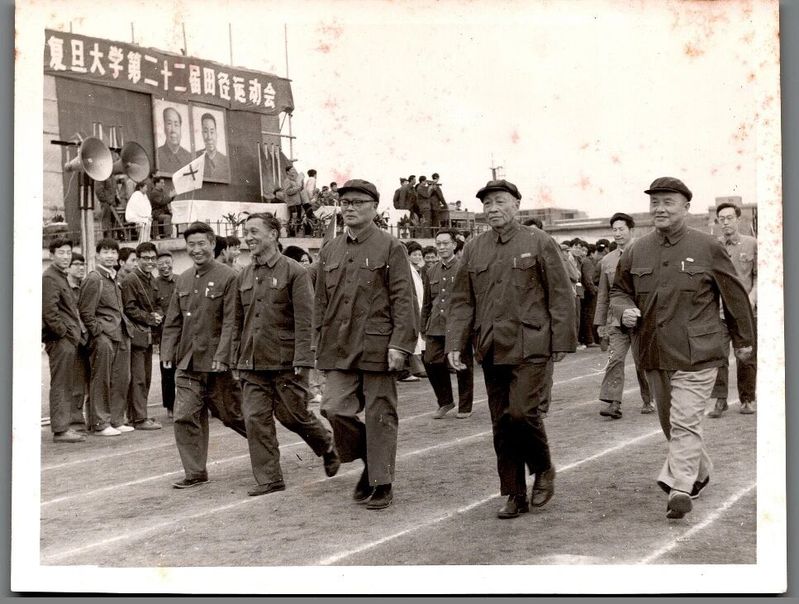
TAN Jiazhen (far right) at Fudan’s track-and-field meet; Ross and her students were there as well.
TAN Jiazhen, the renowned geneticist and then vice-president of Fudan University, went out of his way to welcome her, giving the American student a personal tour of campus. Because summer vacation was still under way, and the cafeterias were not fully open to the public yet, “Professor Tan told me if I was not used to the food, I could get more food at the campus grocery and showed me where to find it,” Ross recalled.
Throughout the 1980s and 1990s, Ross often returned to China for work, and she would be able to see Tan from time to time over the years. In 1985, when Tan was elected an international member of the U.S. National Academy of Sciences, he invited Ross to the induction ceremony held in Washington D.C. as his guest. “Our friendship over the years was very important to me,” she said.

Ross (left) and XIE Xide (right) looking at photos together
XIE Xide, the renowned physicist and then vice-president of Fudan University who had earned degrees at Smith College and MIT, was equally welcoming. “She invited me to her home and we looked at photographs together.”
Ross summed up their kindness with a Chinese proverb——“饮水不忘掘井人”(Drink water, remember the well-diggers.),believing these Fudan professors who studied in America were the earlier bridge-builders in US-China educational exchange.
Teaching at Fudan

During her trip to Fudan this time, Ross also revisited the College of Foreign Languages and Literatures. Seeing her name listed among the foreign teachers in the college’s history, she broke into a delighted smile.
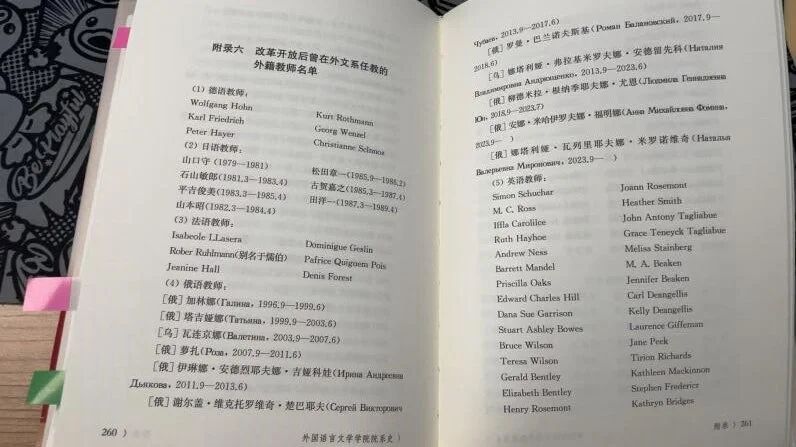
Before she set off for Shanghai in 1979, half her suitcase had been crammed with textbooks; she had no idea how good her students’ English would be. The university wanted to put her up at the Jinjiang Hotel at first, but she asked to live on campus instead. “I would really like to live on the campus, so I could get to know my students and other teachers better.”
Ross’ students at Fudan entered the university in 1978 and were about the same age as she was. In those days, native English speakers from America were rare in China. “There were some teachers from England, but not many from America, so they were happy to have an American (teacher), because they could learn American English accent.”

The diligence of the students left a deep impression on her, and she felt blessed to have such motivated, bright students. But without an immersive language environment, the students lacked practical skills in English writing and speaking.
After her first test—an essay, not a grammar drill—the students were a little “unhappy”. “They were mostly used to memorizing vocabulary and grammar rules but I said I know you can memorize those things, but I want to test your ability to write more naturally.”
She also introduced role-playing to the class: the ongoing 1980 U.S. presidential election became a speaking-class simulation, for example Students researched the candidates Carter, Reagan and Kennedy, then “campaigned” in character. “My students did enjoy role playing and that exercise got everybody to break the ice.”
She taught the class English lyrics by playing American folk songs on a small cassette player. “Sometimes they really liked the songs, and learned them by heart. We sang them in the class. It was a really beautiful memory.”
Back then, word of disco had already reached China, and because Ross had studied dance back home, students would come up and ask Ross to teach them some moves. “I had fun dancing with the students.”
Rekindling dialogues
“Each time I come back to China, I feel there’s greater confidence here,” Ross said. “It’s not just about new buildings and economic growth, it’s the way that people live their lives and relate to the outside world.”
During her recent visit to Fudan, she also held a discussion with the American students studying here. She believes both of the countries need to train future leaders who deeply understand each other’s country.
“If you don’t spend significant time in China, integrating yourself with daily life in China, you won’t deeply understand the Chinese perspective, or the society and culture.” said Ross.
She has long been a driving force behind exchanges and cooperation between the two countries. Under her leadership, USCET and the 21st Century China Center’s China Data Lab at UC San Diego jointly published a data-rich report entitled “Three Decades of Chinese Students in America, 1991-2021”, which was designed to inform policy and highlight the voices of former Chinese students in the ongoing educational dialogue.
“But the number of students going in both directions has not recovered after the pandemic. In particular, the number of Americans studying in China now is completely inadequate. It’s not enough for our country. It’s not enough for our relationship with China,” she said. And for senior scholars who want to do substantive research in China, it’s even harder to find a host institution here
Ross hopes the U.S. universities that have opened outposts in China will keep growing, and that colleges on both sides will maintain strong relations and expand their joint programs.
She also looks ahead to a new generation who will both gain from and fuel this educational exchange—more beneficiaries, more bridge-builders.
(END)
Writer: WANG Mengqi
Editor: LI Yijie