
Quantum technology has been designated as a strategic growth engine in China’s future industrial plan. The United Nations General Assembly (UNGA)’s proclamation of 2025 as the International Year of Quantum Science and Technology, together with recent Nobel Prize in Physics accolades in the field, marks the accelerated transition of quantum technologies from research to real-world application.
Quantum computers are poised to become super brains for tasks like temporal forecasting, drug discovery, and cryptography—capable of exploring all pathways of a maze at once and simulating the quantum realm that underpins our reality.
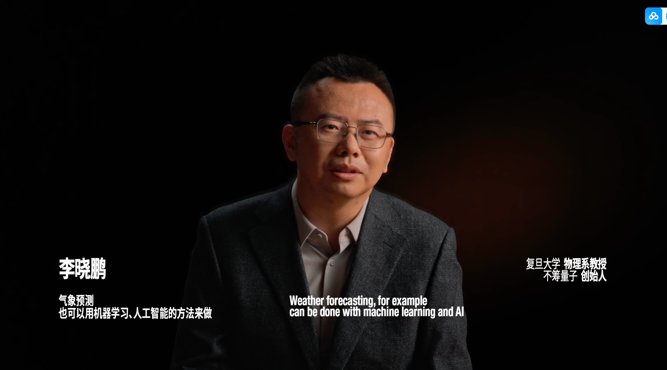
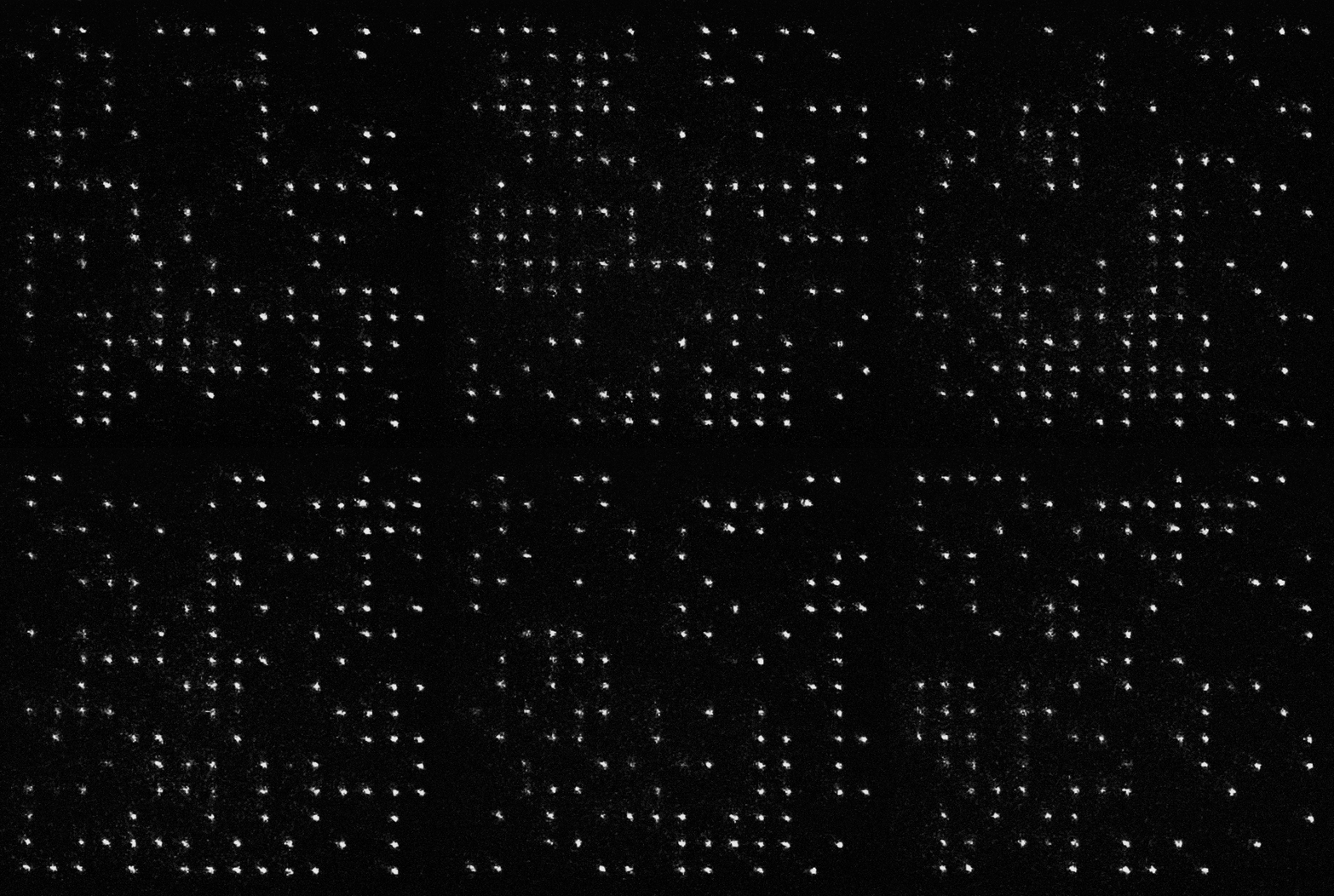
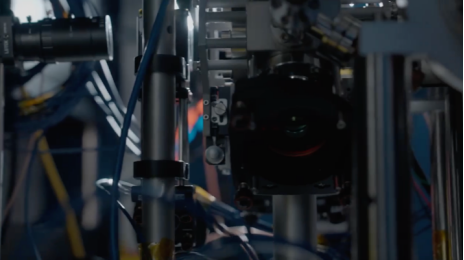
Professor LI Xiaopeng of Fudan University’s Department of Physics, founder of the company BuChou Quantum (in Chinese: 不筹量子), leads a team advancing neutral-atom quantum computing. By employing laser cooling, optical tweezers, and optical lattice techniques, they trap and arrange individual neutral atoms into configurable arrays, constructing stable, controllable, and scalable quantum information processing systems. This approach stands out as one of the most promising routes toward practical quantum computation.
The technology aims not only to deliver lower-cost computational power and finer measurement precision for specific tasks, but also represents a fundamental shift in how we measure and manipulate information—redefining computing at the atomic scale.
Superposition as “Multiverse”
If a classical bit is like a static coin that must show either heads or tails, a quantum bit (qubit) resembles a coin spinning so fast that it exists in a superposition of states—simultaneously both heads and tails—until measured, when it collapses into one definite outcome. The immense potential of quantum computing arises from this intrinsic parallelism: when hundreds or thousands of entangled qubits evolve together, they collectively explore the vast solution space of a computational problem. The neutral-atom platform pursued by Professor Li’s team offers an ideal physical system to realize such complex quantum states, opening the path to exponential speedups for problems that remain intractable for even the most powerful classical supercomputers.

Q: How would you describe your research to someone without a technical background?
Li:Quantum computing is quite an abstract concept—a disruptive computational paradigm for the future. Unlike classical computing, which relies on deterministic states, quantum computing exploits superposition, as if creating a multiverse that evolves in parallel. This gives it a natural capability for parallel computation.
You can think of a classical bit as a coin showing either heads or tails. A quantum bit is more like a coin spinning rapidly, existing in a superposition of both. Measuring it is like slapping the coin onto a table—forcing it into one definite state. In an actual computation, we might have hundreds or thousands of such “spinning coins,” all interconnected in complex ways.
Q: Since our world is fundamentally quantum, is quantum computing essentially a way of simulating nature’s own rules?
Li: We now understand that nature is quantum at its core. One original motivation for quantum computing was indeed to simulate natural phenomena, which are often too complex for classical computers to model accurately. While classical machines can handle relatively simple systems, creating a true digital twin of our quantum world will require quantum computers.
Q: What kinds of problems can quantum computers solve that classical computers cannot?
Li: This is a major focus of current research. For example, boson sampling has been rigorously proven to provide an exponential quantum advantage—the larger the problem, the greater the speedup, a fact already demonstrated experimentally. The much-publicized quantum supremacy experiments a few years ago were based on this. Random circuit sampling is another proven area of quantum speedup, though neither yet has clear practical applications. Applicable areas are likely to include:
First, integer factorization—solving this efficiently on a quantum computer could break RSA encryption, with major implications for national security. Once thought distant, this is becoming increasingly more feasible.
Second, quantum simulation, such as modeling electron behavior in high-temperature superconductors or large molecules. This is extremely challenging on a classical computer but could be done far more efficiently on a quantum computer.
In artificial intelligence, certain problems have benefited from quantum speedups, though significant hurdles remain.
Turning Quantum States into Engineering Reality
BuChou Quantum recently secured tens of millions of yuan in angel funding. Its core team, averaging around 30 years old, originates from Fudan University’s Neutral-Atom Quantum Computing Laboratory. Their challenge is to transform sophisticated physics into reliable products: using quantum error correction to build robust logical qubits from fragile physical ones—the essential step toward scalable, universal quantum computing. This young team is now integrating complex optical, vacuum, and control subsystems into standardized, modular components and full-stack machines, laying the production foundation for the coming era of quantum-powered computation.

Q: We’ve heard about the promise of quantum computing for a long time. Is now the right time to move from concept to machine?
Li: I returned to Fudan in 2016 to workon quantum algorithms and simulations—it wasn’t a popular field back then. Recent progress has convinced us that quantum computing has finally turned a corner. While the core principles haven’t changed in forty years, the supporting technologies have advanced dramatically.
Before this year’s Nobel recognition, the university leadership, the Science and Technology Commission of Shanghai Municipality, and the Ministry of Science and Technology of China had realized the significance of our team’s work and provided strong support. We have raced ahead in the field of neutral-atom quantum computing, particularly in quantum optimization algorithms, quantum machine learning, and quantum simulation. Now, we are accelerating our push toward building a quantum computer with practical utility.
Recently, we have successfully trapped and controlled arrays of alkali atoms on a scale of a thousand atoms, demonstrating both single- and two-qubit gate operations. Furthermore, in our study of neutral atom arrays, we have discovered that long-range interactions combined with quantum fluctuations can induce double supersolid phases. These achievements bring our work close to the international forefront in the field.
Driven by the relentless push from micro- to nano- and sub-nanometer fabrication, computing has entered the quantum domain. Controlling individual atoms is no longer just possible—it’s the essential path forward. This necessity, coupled with the urgent need for more powerful computing paradigms, propels quantum information technology into a pivotal role.
Q: What motivated you to transition from professor to founder of a start-up company? What are Buchow Quantum’s near-term plans?
Li: Founding Buchou Quantum was a decision grounded in several considerations. Applying first-principles thinking, we see that quantum computing demands both deep scientific innovation and rigorous engineering execution.
We already possess strong R&D capabilities in software and hardware; what we needed was the engineering discipline to turn prototypes into products. Creating this company became essential to competing at the highest level. We are now defining our product, roadmap and milestones. In the near term, our primary goals are to deliver fully customizable quantum machines and quantum cloud services. In parallel, we are productizing key enabling components, such as our objective lenses and magneto-optical traps, to be offered as ready-to-use products.
My deepest hope is to see quantum computing become a practical reality, and I believe it is something genuinely within reach for our generation. The chance to help shape this transformative technology during our careers is an extraordinary privilege.
Q: Which early visions of quantum computing have been realized, and what are the biggest hurdles left?
Li: The earliest conceptions of a quantum computer outlined several core requirements. These include the ability to initialize a quantum state, execute high-fidelity quantum gates, and perform accurate measurements. We now face two critical challenges. Due to the inherent fragility of quantum states, quantum error correction is essential to achieve scalablequantum computing. We also need to developmore quantum algorithms that deliver tangible speedups for problem solving.

Q: How does AI help achieve better quantum control?
Li: We employ the reinforcement learning method in our research. It’s like having AI play a game and telling AI that its goal is to control atoms. AI improves through the reward and punishment mechanism of reinforcement learning. For example, in experiments where atoms are loaded into optical tweezers using AI to optimize the parameters, AI is assigned a higher reward for achieving a higher loading success rate. Through iterative experiments, the AI learns to optimize the entire experimental procedure.

Q: Could quantum computing, in turn, make AI more powerful?
Li: Personally, I think an important observation in AI development right now is the Scaling Law: more data and more complex networks lead to emerging higher intelligence. Although the underlying principles aren’t clear, massive numerical experiments and experience with large language models have confirmed the Scaling Law.
I am convinced that quantum-empowered AI holds tremendous, surprising potential. The key lies in the intrinsic complexity of quantum circuits, which grants them superior representational power. This, I believe, translates directly into a higher order of intelligence.
Precision Engineering & Quantum Logic of Tomorrow
The prospects unlocked by quantum computing signal a paradigm shift. From on-demand material design and ultra-precise global models to AI with deeper reasoning, this goes beyond better hardware—it embodies a new way of programming the very substrates of matter, information, and intelligence itself.
Researchers will be able to initialize and guide quantum states through any desired evolution. Imperfections would be actively compensated for, enabling near-perfect results through built-in error correction.

Q: How is quantum computing being applied today?
Li: Shanghai recently released a list of ten quantum computing application scenarios spanning finance, weather forecasting, cryptography, biopharma, and new materials. Several directions already show great potential, though sustained effort from all stakeholders is still needed.
Q: How might the public benefit from your work ten years from now?
Li: Quantum computing could provide an transformative alternative to any field that relies on massive computing power. Take weather forecasting, for example. One day, the public might check two different forecasts: one from a classical supercomputer, and another from a quantum computer. If most people consistently find the quantum-based forecast more accurate and reliable, that alone would prove its practical worth.
Quantum methods are especially promising for analyzing complex, time-dependent data. Closer to our daily lives, the discovery of new materials, which today still depends heavily on trial and error, could be transformed. Imagine designing materials from the ground up for specific functions.That capability would reshape every field.
Q: Classical computing is like walking a maze one path at a time. Can quantum computing offer a bird’s-eye view of the maze?
Li: The maze analogy fits well. There’s a field called Quantum Walk. Unlike classical walks that follow a single path, quantum walks explore multiple routes simultaneously, finding exits much faster.
Consider a maze with 1000 junctions. The number of possible paths is 2^1000—an astronomical figure. Classical search would need to check essentially all options, while a quantum algorithm could reduce the effort to a polynomial function of 1000, delivering an exponential speedup in practice.
Think of a maze with 1,000 junctions. The number of possible paths, 2^1000, is unimaginably large. A classical search would have to try them one by one. A quantum algorithm, leveraging superposition, could explore many paths at once and find the solution in just seconds— an exponential speedup.
Q: Do you consider yourself a pioneer in your field of research?
Li: In my view, scientists are creators of keys. We forge the crucial technologies that unlock doors to the future. History isn’t made by individuals alone: Turing conceived his machine, others built the first computers, and later generations gave us the internet and AI. They couldn’t foresee today’s world, but they crafted the keys, opened the doors, and revealed new horizons.
Today, we are building quantum computers, designing algorithms, and bringing them to market. Once foundational problems are solved, how this technology is usedand what kind of world it helps shapewill be decided collectively by society and the market. That new world isn’t something we invent from nothing. It was always there, latent, waiting to emerge. And what it grows into will ultimately have a life of its own.
(END)
Translated & Adapted by Edward Turdmat