
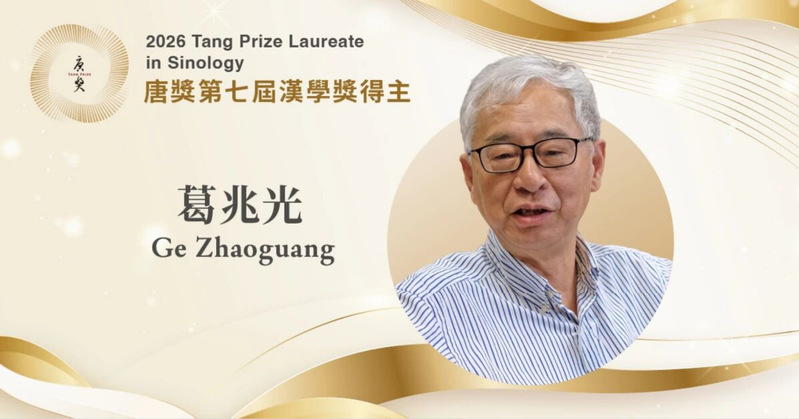
When Fudan University historian Ge Zhaoguang received the 2026 Tang Prize in Sinology, he joined a select group of scholars whose work has fundamentally shaped global understanding of Chinese civilization. Established in Taiwan in 2012, the Tang Prize has emerged as one of the world’s most prestigious international awards in the humanities and sciences. Its Sinology Prize honors scholars whose research has transformed the study of China, and previous recipients include such distinguished figures as Yu Ying-shih, William Theodore de Bary, Stephen Owen, Wang Gungwu, Jessica Rawson, and Hsu Cho-yun.
Ge’s selection represents a significant recognition of an extraordinary scholarly career. It also highlights the growing role of Fudan University as a leading international center for the study of Chinese history, thought, religion, and culture. At a time when discussions of China are increasingly shaped by questions of economics, technology, and geopolitics, Ge’s work reminds us that some of the most important questions about China remain historical: What is China? Who defines it? How have its cultural and intellectual boundaries evolved over time? And how can scholars understand China in all its complexity?
For decades, Ge has pursued these questions with intellectual rigor and remarkable originality. His answers have reshaped the field of Chinese intellectual history, influenced generations of scholars, and expanded international understanding of China’s past.
Reimagining Chinese Intellectual History
For much of the twentieth century, Chinese intellectual history was largely written as a history of great thinkers. Scholarly narratives focused on canonical figures such as Confucius, Zhu Xi, and Wang Yangming, emphasizing philosophical doctrines and elite textual traditions.
Ge challenged this conventional framework.
His landmark work, An Intellectual History of China, Volume One: Knowledge, Thought, and Belief before the Seventh Century CE, proposed a broader understanding of intellectual life. Rather than limiting intellectual history to formal philosophical systems, he argued that it should encompass the wider universe of knowledge, beliefs, customs, rituals, and assumptions that shaped everyday existence.
This represented more than a methodological innovation. It fundamentally redefined the subject itself.
Ge shifted attention from the center to the margins, from canonical texts to lived experience, and from elite intellectual traditions to the everyday knowledge that enabled societies to function. In his view, the beliefs of ordinary people, the circulation of common knowledge, and the religious and cultural assumptions embedded in daily life are no less significant than the ideas recorded in classical texts.
By bringing these neglected dimensions into historical analysis, Ge helped open new conversations between intellectual history, cultural history, social history, and religious studies. His work expanded the scope of Chinese historical inquiry and offered a model that resonates with broader developments in global historiography.
Bringing Religion Back into History
A second hallmark of Ge’s scholarship is his pioneering work on religion.
For decades, many historical narratives treated religion as a secondary phenomenon, subordinate to political institutions or philosophical systems. Ge demonstrated instead that Buddhism, Daoism, and popular religious traditions were central forces in shaping Chinese civilization.
Through influential studies such as Chanzong Yu Zhongguo Wenhua (Chan Buddhism and Chinese Culture), Daojiao Yu Zhongguo Wenhua (Daoism and Chinese Culture), and Zhongguo Chan Sixiangshi: Cong Liu Shiji Dao Jiu Shiji (An Intellectual History of Chinese Chan: From the Sixth to the Ninth Century), he examined how religious beliefs transformed intellectual life, social values, and cultural practices.
His research illuminated the localization of Buddhism in China, the evolution of Daoist traditions, and the interactions between religious communities and political authority. Rather than viewing religion as a passive reflection of larger historical processes, Ge revealed it as an active force in the formation of Chinese society.
Perhaps most importantly, his work showed that understanding Chinese history requires moving beyond official documents and elite discourse to consider the beliefs and practices of ordinary people. In doing so, he broadened the analytical horizons of both Chinese and international scholarship.
The Question: What Is China?
In recent decades, Ge has become internationally known for addressing one of the most consequential questions in Chinese studies: What is China?
Through a trilogy of influential books—including Here in ‘China’ I Dwell: Recounstructing Historical Discourses of China for Our Time, What Is China? Territory, Ethnicity, Culture, and History, and The “interior” and the “exterior” in historical China: A re-clarification of the concepts of “China” and the “periphery”—he challenged the assumption that China is a fixed and self-evident historical entity.
His argument is straightforward but profound. China, he suggests, has never been a static geographical, political, or cultural unit. Rather, its meaning has evolved through centuries of interaction among peoples, territories, religions, languages, and neighboring civilizations.
This perspective shifts attention away from viewing China as an isolated civilization and toward understanding it as a dynamic historical process.
A distinctive feature of Ge’s approach is his insistence on examining China from the perspective of its neighbors. Drawing extensively on Korean, Vietnamese, Japanese, and other Asian sources, he reconstructs how surrounding societies perceived China and how those perceptions influenced China’s own self-understanding.
This methodological innovation—what might be called “viewing China from the periphery”—has had a profound impact on historical scholarship over the past decade. It has encouraged researchers to place China within wider regional and transnational networks and to reconsider long-held assumptions about cultural boundaries and historical identity.
In an age of increasing global interconnectedness, Ge’s work offers a compelling framework for understanding how civilizations define themselves through interaction with others.
Why This Matters
The significance of Ge’s Tang Prize extends beyond the field of Sinology.
At a time when global attention is focused on China’s economic growth, technological innovation, and geopolitical influence, Ge reminds us that understanding China also requires understanding the historical ideas, beliefs, memories, and cultural traditions that have shaped Chinese society over centuries.
His scholarship demonstrates that China is not merely a contemporary nation-state. It is also a historical process, an evolving cultural space, and a continuing intellectual conversation about identity, community, and civilization.
These questions are not unique to China. Across the world, societies are grappling with issues of historical memory, cultural identity, and the relationship between national traditions and global interconnectedness. By exploring how China has defined itself across time, Ge’s work contributes to broader conversations about how civilizations understand their place in the world.
The Tang Prize recognizes scholars whose work has fundamentally expanded human knowledge. Ge Zhaoguang’s achievement lies not simply in producing influential studies of Chinese history. Through decades of scholarship at Fudan University, he has transformed how scholars think about China itself.
His work demonstrates the enduring value of rigorous historical inquiry, interdisciplinary research, and international scholarly dialogue.
Fudan and the Global Study of China
Ge’s achievements are inseparable from the intellectual environment in which they developed.
As one of China’s leading research universities, Fudan University has long played a prominent role in advancing the humanities and social sciences. Through sustained investment in interdisciplinary scholarship and international academic exchange, the university has become an important platform for global dialogue on Chinese civilization and world history.
This commitment is reflected in Ge’s own institutional contributions. As the founding director of National Institute for Advanced Humanistics Studies at Fudan University, he helped create a space where scholars from history, philosophy, literature, religion, art, and related disciplines could engage in sustained intellectual collaboration.
The institute embodies a vision that has guided Ge’s scholarship throughout his career: that the most important questions about culture and civilization cannot be confined within disciplinary boundaries.
Over the past two decades, Fudan has increasingly emerged as a bridge connecting Chinese scholarship with international academic communities. Scholars affiliated with the university regularly participate in major global conversations on history, philosophy, area studies, and civilization comparison. Ge’s work stands as one of the clearest examples of how research rooted in Chinese intellectual traditions can contribute to broader international debates.
His international recognition therefore reflects not only individual accomplishment but also the growing influence of Chinese universities—and Fudan in particular—in shaping the future of global humanities scholarship for generations to come.
(End)
Presented by Fudan Unversity Media Center
Writer: Deng Jianguo