
During the 2026 Shanghai Forum, we had the opportunity to sit down with Dr. Golestan Sally Radwan, Chief Digital Officer of the United Nations Environment Programme (UNEP), to discuss the intersection of artificial intelligence and the environment.
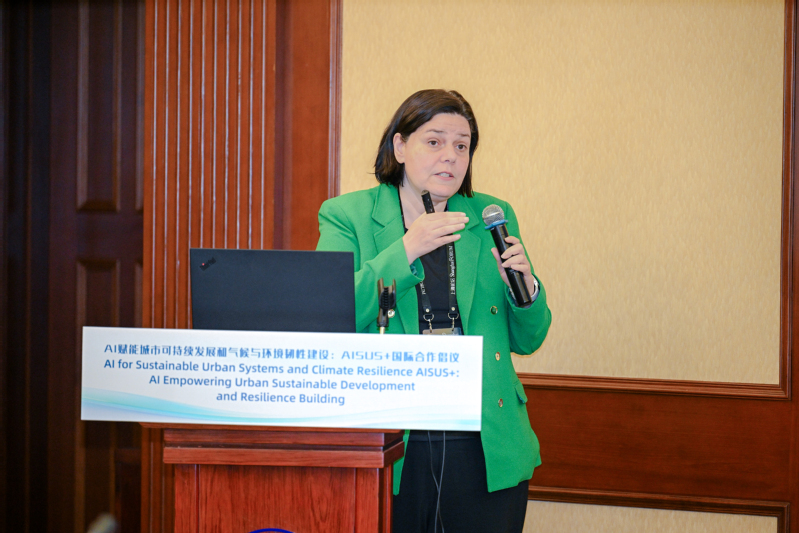
Our conversation took place at the sub-forum “AI for Sustainable Urban Systems and Climate Resilience (AISUS+): AI Empowering Urban Sustainable Development and Resilience Building,” where Dr. Radwan delivered a talk titled “AI & the Environment: Opportunities, Risks — Shaping What Comes Next.”
We discussed the environmental challenges posed by AI, new forms of international cooperation needed to address them, and the inequalities that AI has exacerbated. Dr. Radwan also shared valuable advice for students at Fudan University who aspire to pursue a career in sustainable development.

Q: What are the major challenges that artificial intelligence poses to climate change? Are they different from traditional challenges?
A: If we talk about the changing picture of climate change—and I’ll broaden that to the environment as a whole, not just climate—AI is becoming very interesting.
There is a lot of promise around how AI can help with climate change and environmental science: tracking, forecasting, and many other applications. But when you look at the challenges, the picture looks very different.
Everyone knows that AI has an environmental footprint. AI has a significant environmental footprint across its entire lifecycle, from material extraction and manufacturing to shipping and data center construction.
AI also has indirect, secondary effects. It’s like land degradation, for example, which happens over a long period of time. If you’re extracting that much water from the surrounding environment, eventually you will have drought. And the biodiversity around those sites changes quite significantly. These are the kind of slow-onset events that you don’t normally factor into planning, but eventually they become very visible.
So the picture is quite complex, and it’s not exactly the kind of climate change effects we’re used to, like rising temperatures or sea level rise.

Q: How to cope with that on a global scale? Will we need a new international cooperation framework for these challenges?
A: It’s very difficult in the current geopolitical climate to get anything agreed, let alone binding. But there are some glimmers of hope.
Last December, at the UN Environment Assembly, essentially the UN General Assembly for the environment, we passed a resolution on AI and the environment. It was the first UN-wide resolution at that intersection. And this year, we’ve been talking a lot about physical AI as well.
We discussed robots, but also embedded AI in all the devices and all the things we see around us. What’s the environmental footprint of that? Is it better to move computing and AI modeling to the edge? And is it better to have a local model running on my watch instead of on a data center somewhere? Is that more or less harmful to the environment?
There is hope, but it is a bit slow-moving.
Q: There are inequalities between developed and developing countries. Will AI improve that situation or make it worse?
A: With all things related to AI, the answer isn’t straightforward. I think it does offer some opportunities—things like personalized learning and the ability to access information and knowledge more quickly.
But at the same time, it also exacerbates the divides and inequalities we already suffer from today. The gap isn’t just between the Global North and the Global South. It’s also between companies within the same country. And that divide is becoming more and more visible.
Knowledge is concentrated, and therefore power is concentrated in the hands of these companies. Some of them are also trying to consolidate the energy value chain. They’re buying up old nuclear reactors to power their own data centers, going completely off the grid. And since their primary KPI is profit, no one can really see what they’re doing.
So if it’s more profitable for a company to have people creating cat videos all day long, then that’s what they’ll do. They don’t care about the environmental footprint or the inequalities that generates. But even for those driven by a public-good mantra, whether governments, NGOs, or scientific groups, they lack the knowledge and the capabilities. Because it’s so expensive. Hardware is becoming scarcer and scarcer.
Now it’s getting even harder. The ability to develop and harness these so-called frontier models is becoming more and more concentrated. Many of those sophisticated skills, advanced education, and research capabilities are simply not available in the Global South.

Q: Would you like to give the students in Fudan University who want to pursue their careers in sustainable development some advice?
A: There are enormous opportunities out there. It’s a fascinating time to start learning these things.
Becoming an interdisciplinary thinker is more important now than ever. One really needs to understand causes and effects across different domains, especially in fields like international relations, because it’s no longer just about delivering the right words at the right time.
The second thing is to get as much exposure as possible to whatever lies outside one’s own bubble. Whether you’re in a certain part of China, ask yourself: what are other provinces doing? What does the divide look like? And beyond China, what does the rest of the world look like?
The other thing is innovation. When discussing the risks of AI, the focus tends to be on governance, laws, stopping, harnessing, and limiting. All of that is important, but it’s not the whole story. Significant innovation of the new generation can be done to make AI more sustainable, more resilient, and more useful.
China has been a pioneer in that regard, partly driven by geopolitical imperatives, but also by the ingenuity and innovation power of Chinese scientists. How do we do more with less? Do we need giant data centers with expensive GPUs, or can we build something like DeepSeek on relatively cheap GPUs? And how do we make the models themselves more efficient?
Large language models are very wasteful. The question is how to make them more compact and efficient. Could mixture-of-expert models—small models specializing in different tasks, called upon demand—be a solution? Should innovation focus on edge devices rather than large data centers? There is ample room for innovation, for new startups to emerge, and for scientific progress to make AI more sustainable, alongside regulation and international norms.
(END)
Writer: ZENG Keying
Proofreader: YANG Xinrui
Editor: WANG Mengqi, LI Yijie