
The Future Science Prize committee announced the laureates of today. Prof. ZHAO Dongyuan, academician of the Chinese Academy of Sciences and dean of College of Smart Materials and Future Engergy at Fudan University, receives the Future Science Prize in physical sciences for pioneering contributions to mesoporous materials in the context of synthetic control, mechanistic understanding, and industrial application.
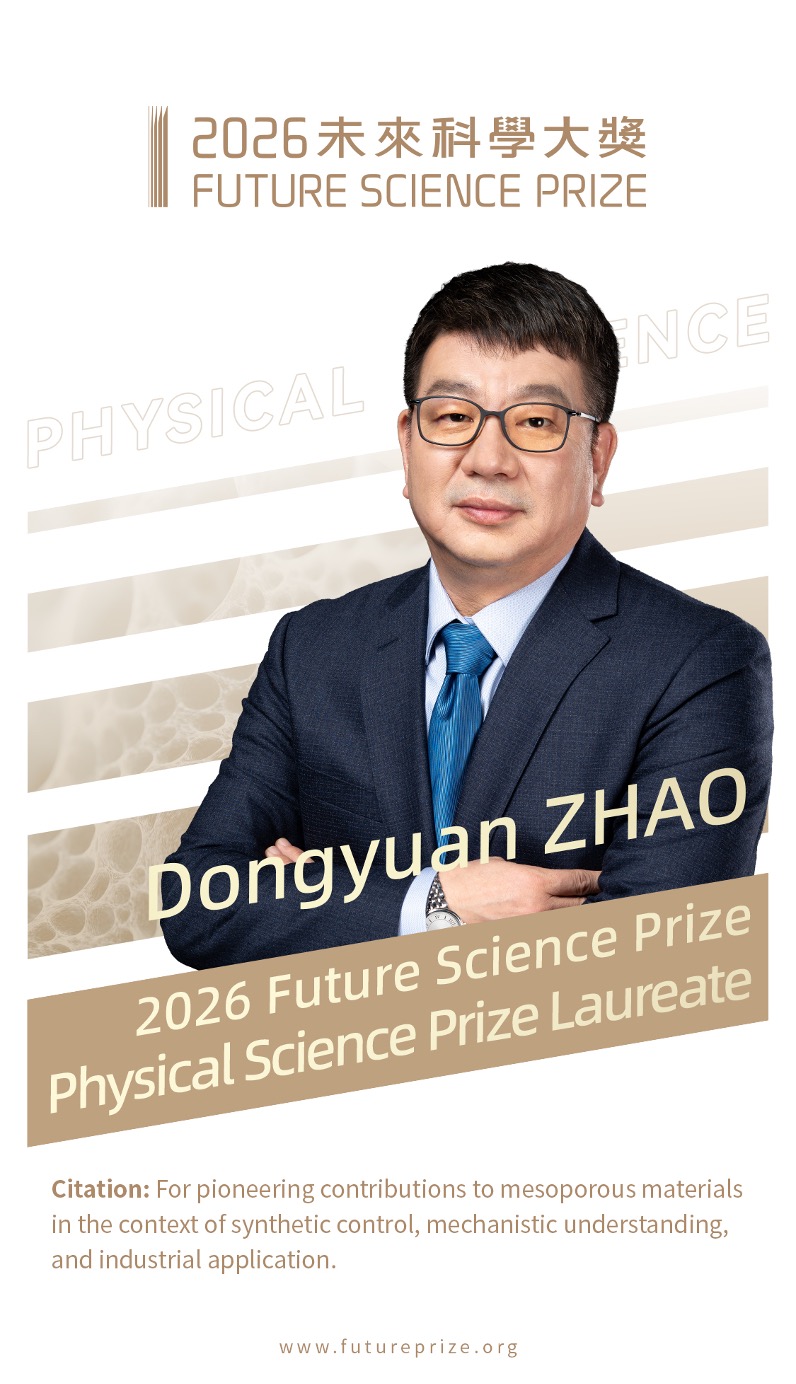
2026 Future Science Prize Laureate in Physical Sciences

ZHAO Dongyuan
Mesoporous materials are solids containing pores of 2-50 nm in diameter. They are indispensable for a broad range of applications, including catalysis, energy conversion and storage, environmental remediation, and biomedicine. How to tune and precisely control the size, order, and surface composition of the pores has long been the Holly Grill in materials chemistry. Up till the late 1990s, it remained a challenge to synthesize ordered mesoporous materials with tunable pore sizes, diverse compositions, and broad functionalities.
Since 1998, Zhao has developed many innovative, robust, and scalable methods based on molecular self-assembly to produce ordered mesoporous solids with unprecedented precision in terms of pore size, compositional, and structural controls. One of the major contributions by Zhao is a thorough understanding of the self-assembly process under different experimental conditions. The synthetic methods developed by Zhao have been widely adopted worldwide to produce functional porous materials with well-controlled properties for a broad range of applications. His original studies greatly expanded the scope of mesoporous materials and rapidly transformed them into a class of technologically important materials.
Zhao’s innovative work has brought mesoporous materials to the forefront of chemistry, materials science, and nanotechnology by establishing these functional materials as a transformative platform for broad applications in heterogeneous catalysis, energy storage and conversion, environmental protection, and biomedicine. Significantly, he has bridged fundamental research with practical application, translating his innovations into impactful industrial technologies, such as heavy-oil/residual-oil hydrocracking in petrochemical industry, silicon-carbon anodes for Li-batteries, and low-dielectric (low-k) materials for printed circuit boards.
Representative Publications:
[1] Science 1998, 279, 548–552.
[2] Angew. Chem. Int. Ed. 2005, 44, 7053–7059.
[3] J. Am. Chem. Soc. 2008, 130, 28–29.
[4] Nat. Rev. Mater. 2016, 1, 16023.
The Future Science Prize
The Future Science Prize was established in 2016 by a group of Chinese scientists and entrepreneurs. Focused on original basic research, the prize invites international peer review and is decided by a professional committee of distinguished scientists.
The work recognized by the Future Science Prize must satisfy each of the following criteria:
01. Have a seminal and profound impact internationally;
02. Exhibit originality and long-term significance, and/or have stood the test of time;
03. Completed mainly in the Chinese mainland, Hong Kong, Macao, or Taiwan. There is no restriction on the nationalities of the nominees.
There are three major categories at present, namely the “Life Science Prize”, the “Physical Science Prize”, and the “Mathematics and Computer Science Prize”, with each award of 1 million US dollars respectively.
The Future Science Prize has been awarded to 49 laureates since 2016. All laureates are highly accomplished, widely recognized scientists whose research has made extraordinary impacts in life sciences, physics, chemistry, mathematics, and computer science.
The 2026 Future Science Prize Week and the Award Ceremony will be held in Hong Kong from November 6 to 9, 2026.
(END)
Source: Future Science Prize
Editor: WANG Mengqi, LI Yijie