
“You have to enjoy it.” That, said LIU Xin, is one of the most important questions anyone entering international communication — or any field — must ask themselves: whether the work brings genuine pleasure and a sense of accomplishment. “That is one of the key factors determining how far you can go.”
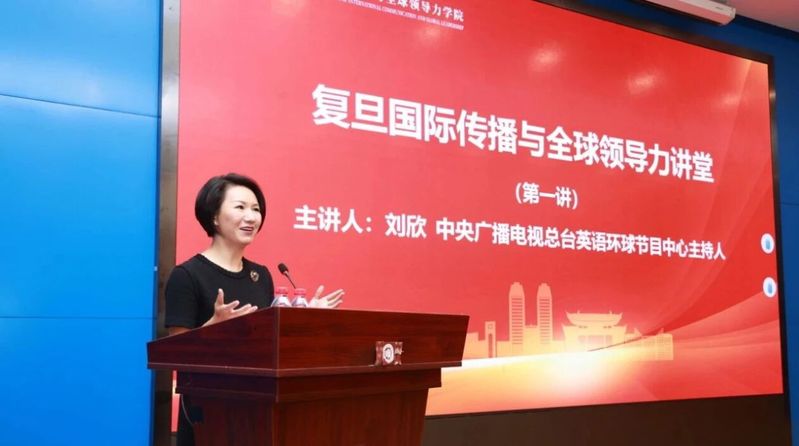
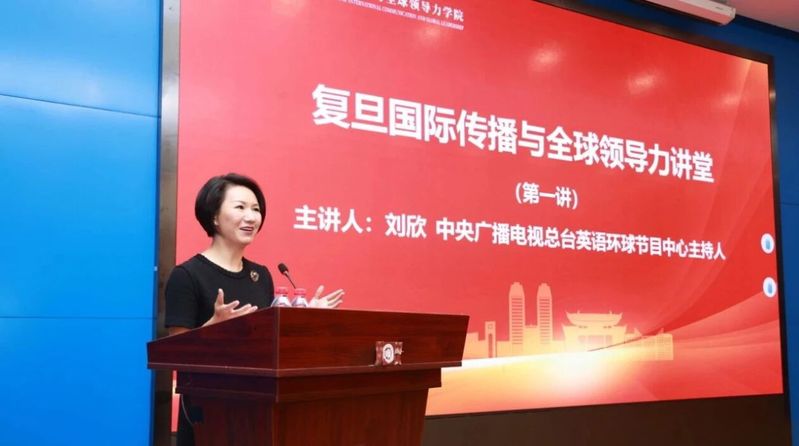
The senior host and journalist at China Global Television Network (CGTN) made the remark on Tuesday at the Fudan International Communication and Global Leadership Lecture, where she spoke face to face with nearly 300 students and faculty members from Fudan’s School of International Communication and Global Leadership. Drawing on three decades of experience talking to the world, she shared the real stories and hard-earned insights behind her career.
That episode, she recalled, taught her that speaking out is not about raising one’s volume, but about seizing the initiative in a complex opinion environment and delivering one’s position clearly and completely. “We must speak up for ourselves and fight for the mic.”
She distilled her experience into eight lessons. The first is simple: Speak up. Faced with controversy in the international arena, communicators cannot afford to stay silent; they must actively claim their space to be heard.

If “speak up” answers whether to speak, “Plan ahead” answers when. Speed matters in international communication, she noted, but true speed is not chasing every trending topic — it is preparing early for issues you can see coming. She had a long-planned interview with Anthony Carty, a renowned scholar of international law, ready to go, so when a story about international law broke, she was able to run it right away. Unadorned but perfectly timed, it achieved far greater reach than expected. Timing, she stressed, is a golden rule in the field that “works every time”.
Revisiting the 2019 debate with Trish Regan, she noted that natural expressions, genuine emotion and a personal touch narrow the psychological distance between communicator and audience. “Communication cannot rest on an abstract institutional identity alone — the audience needs to see a real person with feelings, judgment and character.” That is her third lesson: Humanize ourselves.
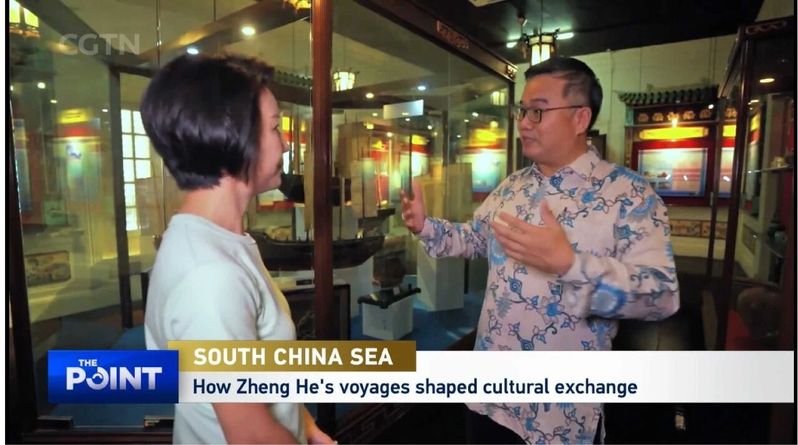
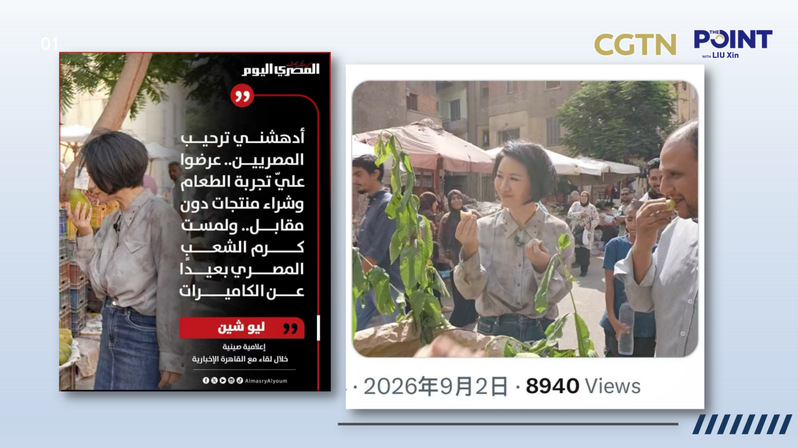
Fourth, People power. Liu turned her gaze from grand topics to ordinary life. Filming in Cairo weeks ago, while her team debated interview plans, she suggested something unexpected: “Let’s visit the local market.” She walked through the vegetable stalls, chatting with vendors and sampling local food — an everyday scene with no grand theme and no elaborate staging. The segment, once released, drew a flood of likes from local media and residents alike.
After 30 years in the field, Liu still pushes her team to explore new tools and fresh ways of telling familiar stories — lessons five and six: Innovate and Visualize. In recent years her team has incorporated AI, virtual reality and word clouds into production. Innovation, in her view, is not novelty for its own sake, but showing audiences something they have never seen — and giving them a reason to stay. “Make the abstract concrete and visible, and your message lands better.” Her toolbox includes charts tracking China’s auto exports, national flags in place of long lists of countries and names, and a “Panda–Kangaroo Friendship Index” to illustrate the China–Australia relationship — all designed to lower the barrier of understanding and make complex issues vivid.

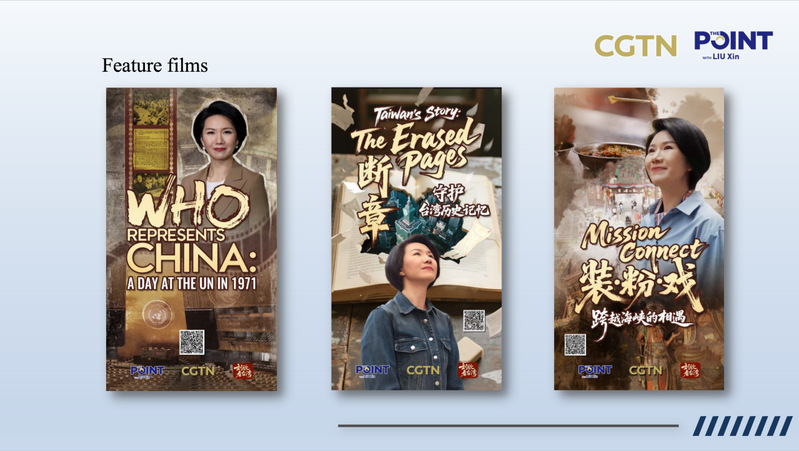
On delivery, she urged communicators to Reject cliché while Increasing exposure. Programs, articles and social posts alike should avoid tired, formulaic language; headlines should inform accurately while inviting the audience to read. And the work does not end when the content is done — every step, from posters and images to trailers and platform promotion, deserves repeated refinement, with packaging adapted to each platform.
In the Q&A that followed, one student asked how to reconcile planning ahead with the unpredictability of news. Liu conceded that news cannot be fully planned, but said long observation allows communicators to prepare for trends that are bound to emerge.

“It’s like putting your ear to the railroad track to hear the train coming. Some topics we can foresee — we may not know exactly when they’ll arrive, but we can do the homework and build the material in advance.”
On teamwork, she described a tight-knit team of about nine or ten built on full mutual trust. “Only when you truly believe in your team, rely on your team, and never disconnect from it can you do your best work.” The relaxation she advocates, she clarified, is not lower professional standards — it is less anxiety and less over-control. “Do international communication with a relaxed mind.”

Asked about the role of local-level international communication centers, Liu said local media have different resource endowments from national outlets; the task is to find the path best suited to oneself and gradually develop distinctive strengths through sustained practice.


CHEN Zhimin, vice president of Fudan University and dean of the School of International Communication and Global Leadership, joined the exchange. The school, he said, aims to train professionals who are ready for the real world — sound in judgement and strong in their field: versatile, globally minded, practice-oriented professionals in international communication.

The lecture is one of the flagship events of the School of International Communication and Global Leadership, which regularly brings top scholars, senior diplomats, chief editors of central media outlets and communications executives of multinational companies to campus.
(END)
Writer: WANG Mengqi
Editor: LI Yijie