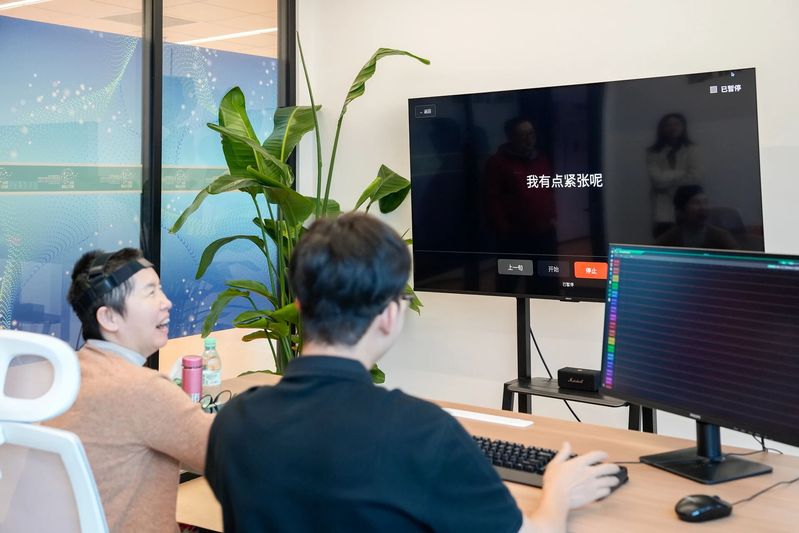

Ms. Li has amyotrophic lateral sclerosis (ALS). Before the implant, even her husband could understand only about a fifth of what she tried to say. Now she need only move her lips slightly, or silently think of a sentence, and her words appear on a screen, read aloud in a voice cloned from her own.
This is made possible by the Chinese-speech dual-target brain-computer interface (BCI) system, a homegrown research milestone developed by the teams of LU Junfeng, MAO Ying and ZHANG Menghan at Fudan University Huashan Hospital and Fudan’s Institute of Modern Languages and Linguistics. They worked with ZHAO Zhengtuo of the CAS Center for Excellence in Brain Science and Intelligence Technology, LI Xue of StairMed and LI Yuanning of ShanghaiTech University.

This September, the team completed China’s first wireless invasive clinical trial of a Chinese-speech BCI at Huashan Hospital, under its Shanghai Key Laboratory of Clinical and Translational Brain-Computer Interface Research. It follows the same lab’s first wireless invasive motor BCI trial in March 2025.
English BCIs decode phonemes, but Chinese is a tonal language: mā, má, mǎ and mà differ only in tone, yet mean entirely different things, so decoding articulation alone is not enough. Building on years of research at Fudan University and ShanghaiTech University into the neural encoding of Chinese tone systems, and on Huashan Hospital’s millimetre-resolution language maps derived from nearly 1,000 brain tumour surgeries, the team has expanded its focus from preserving language function during surgery to recovering speech when disease has taken it away. Two 256-channel ultra-flexible electrode arrays were implanted in two brain regions, one reading phoneme-related articulation signals and the other tone signals, and a dual-stream decoder fused the two.
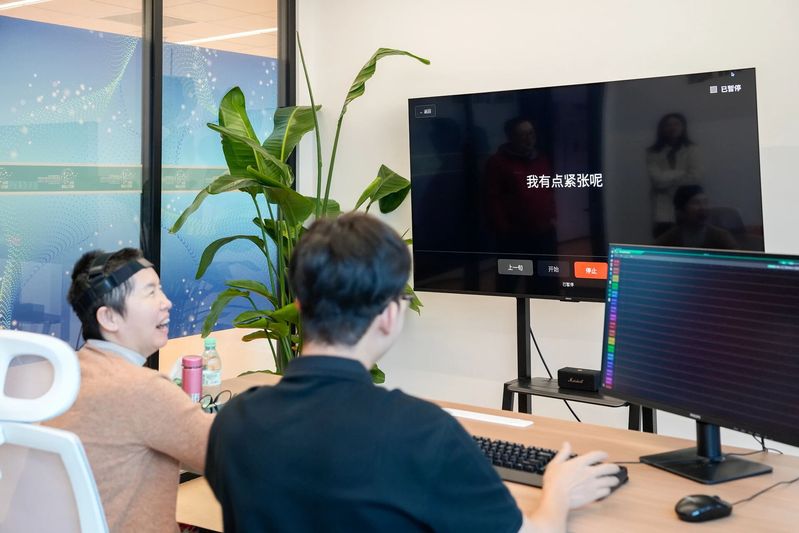
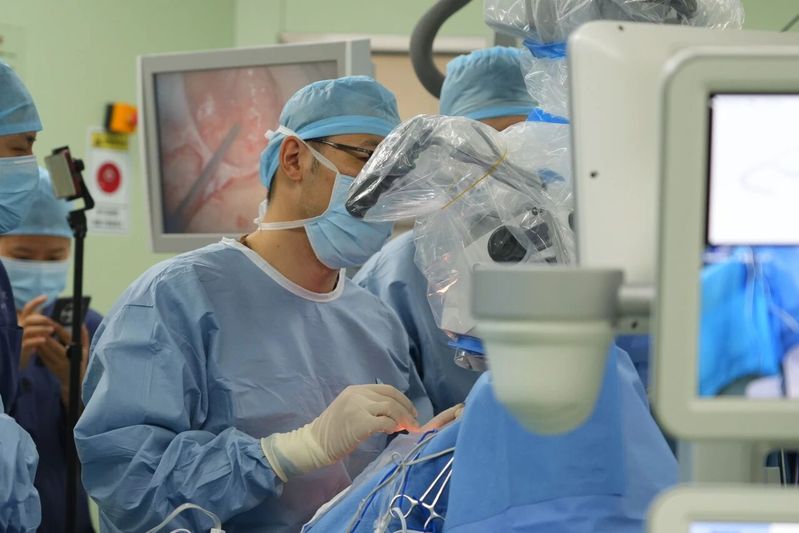 The scene of the wireless invasive Chinese-speech BCI implantation surgery
After about a month of training, the system was evaluated in spontaneous speech tests with theoretical coverage of all Chinese characters. During attempted speech, it achieved real-time Chinese-character decoding accuracy above 95% at approximately 80 Chinese characters per minute. During imagined speech, accuracy exceeded 90% at approximately 110 Chinese characters per minute. Conventional aids such as eye-tracking systems and scalp EEG, require users to select letters one by one to enter Chinese characters, usually stay below 40 Chinese characters per minute.
“The first clinical trial has preliminarily verified the safety and effectiveness of the technology, and it is expected to benefit millions of people with speech disorders nationwide,” said MAO Ying, president of Huashan Hospital. He said the study offers patients with dysarthria a new way to communicate and opens a path toward a BCI technology and knowledge system built for Chinese.
The project is as much a showcase of Fudan’s disciplinary breadth as of the device itself. “Linguistics defines the Chinese-specific problems, brain science locates and reads the signals, clinical medicine delivers the implant and the trial, and engineering and AI turn signals into words,” said ZHANG Menghan, director of Fudan’s Institute of Modern Languages and Linguistics. “The humanities, sciences, medicine and engineering all pull toward the same patient need.”
“Helping patients voice what is in their brain does more than improve their quality of life. It gives them back the equal right to express themselves, so that even in illness they can be seen by the world and embraced by society,” said LU Junfeng, deputy director of Fudan’s Institute of Modern Languages and Linguistics and associate chief physician at Huashan Hospital.
The team will now raise accuracy, improve portability and extend clinical validation to conditions such as post-stroke aphasia, with the technology expected to reach more patients within two to three years. More than half of the world’s 7,000-plus languages are tonal, so the Chinese route may also inform BCI research elsewhere.
“My days are full again. It is a great honour to be the first user of this new technology,” Ms. Li said through the system.
(END)
Writer: WANG Mengqi
Editor: LI Yijie